Hot Foil vs. Cold Foil: Which One Fits Your Project?
Both add metallic shine to print, but they get there in different ways. Here's how to choose. Hot foil and cold foil are both excellent stamping techniques — they simply excel in different situations. Understanding the difference helps you choose the right one for your project, budget, and production volume.
How Hot Stamping Foil works
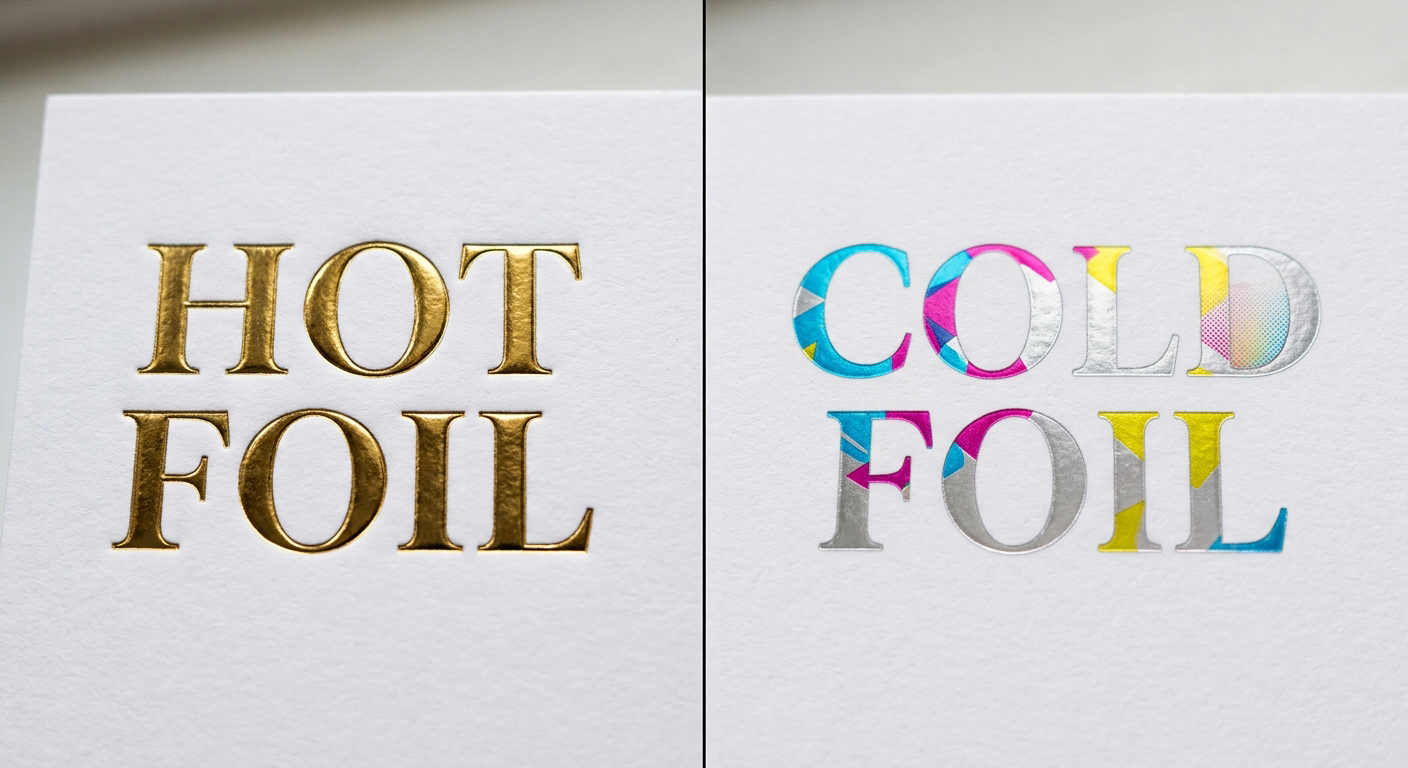
Hot stamping foil is pressed onto the material with a heated metal die. Heat and pressure release the foil layer and bond it to the surface, so only the area shaped by the die picks up the foil.
Strengths
- Crisp, bright results — captures every detail of logos, lettering, and borders with lines as fine as 0.2 mm.
- Works with embossing — adds dimension to foiled work, letting the surface feel more depth than the eye alone can tell
- Wide range of colors and finishes — including metallic, matte, holographic, pearl, pigment, and more
Weaknesses
- Requires a new die for every design — a new die is needed each time the design changes, making it less suited to work that's updated frequently, which today's fast-moving businesses increasingly demand
- Can't produce color gradients — hot stamping foil is limited to the foil's own solid color and can't blend tones or be overprinted with other colors, unlike cold foil, which allows unlimited CMYK overprinting on silver foil
- Slower production speed than cold foil — hot stamping runs on sheet-fed presses at 30–80 sheets/minute, slower than cold foil's inline, high-speed roll-to-roll process
How cold foil works
Cold foil transfers on press through a UV adhesive. The adhesive is printed where the foil should go, the foil is laminated over it, and it sticks only to the adhesive. No heat and no dies are needed.
Strengths
- No die required — designs can be changed quickly and easily, well suited to today's fast-moving business world where everything shifts constantly
- Unlimited color overprinting — built on a silver foil base, with CMYK printed over it to achieve any shade desired
- Fine detail and smooth gradients — the adhesive is printed like ink, so foil can carry fine lines, halftone screens, and tonal gradients
- High production speed — runs inline with existing presses, with no extra separate step needed
- Works on large areas — covers wide foil areas evenly, without the foil lifting or missing spots, and without the die-size limitations hot stamping has
- Gentler on materials — no heat and minimal pressure involved, making it suitable for delicate materials that risk damage from high pressure
Weaknesses
- Needs a smooth surface — results are sharpest on smooth, coated stock; rough or textured materials reduce image quality
- No true embossing — produces only a slight raised texture from the foil itself, not a genuine embossed dimension
- Best suited to paper and plastic — not yet ideal for leather or other specialty materials
Which one should you choose?
| Choose Hot Stamping Foil | Choose Cold Foil |
|---|---|
| For logos or smaller areas that need a bright, eye-catching finish, or when you want embossing, a distinctive holographic pattern, the soft elegance of pearl foil, or the bold intensity only pigment foil delivers. | For large foil areas beyond what a die can achieve, when you need to print color directly over the foil, or when faster production speed matters more. |
Not sure which fits your job? Contact our team and we'll help you compare samples on your own material.